
Hubstaff alternative
The best Hubstaff alternative in 2026
- Most people search for a Hubstaff alternative because they want time tracking without surveillance.
- If you need surveillance — your contracts require it — most alternatives won't satisfy that.
- If you don't, this is the table.
Hubstaff's strengths (screenshots, activity scoring, GPS, payroll) are the exact things many teams switch away from. Pick the alternative based on which job you actually need done.
Why people look for a Hubstaff alternative
- Screenshots damage your team's trust and culture.
- Activity-percentage scores penalise thinking work.
- You don't actually need GPS or per-window monitoring.
- Your clients don't require screenshot evidence anymore.
Hubstaff alternatives compared
Temporal.ist That's us
Free during early accessAutomatic tracking from file edits and URLs with invoicing built in — idle time and PC sleep deducted on their own, offline-first desktop apps plus a headless Linux CLI. No screenshots.
Best for: Freelancers and small teams who forget timers and bill hourly.
Toggl Track
Free up to 5 users; paid plans from ≈ $9/user/moThe polished manual stopwatch. 100+ integrations and best-in-class team reporting.
Best for: Teams that reliably hit start/stop and depend on integrations.
Harvest
≈ $12/user/mo (Pro)Manual timer + mature invoicing with deep QuickBooks/Xero integration.
Best for: Agencies running their billing on QuickBooks/Xero today.
Clockify
Free; paid from ≈ $4/user/moThe 'free forever, unlimited users' manual tracker. Wide feature set.
Best for: Teams whose primary constraint is budget.
Timely
≈ $11–$22/user/moAI-summarised timesheet from comprehensive desktop activity capture.
Best for: People who want an AI draft of their week.
Memtime
From ≈ €11/moVisual day-timeline tracker (Mac/Win/Linux) with strong professional-services traction.
Best for: Teams that want a horizontal timeline reconstruction of the day.
Why teams pick Temporal.ist
Temporal.ist is built specifically against surveillance: file events and URLs, no screenshots, no activity scoring, no keystroke logging. The team features survive the removal — organisations roll up into teams and projects, tracked time aggregates per project and per client, and per-session activity logs (files touched, URLs visited, focused minutes) give clients a better audit trail than a screenshot grid. Idle timeout and automatic PC-sleep deduction keep billed hours defensible without an 'activity score'. Each user sees exactly what's captured about themselves; managers see project totals. If your business model requires monitoring, we are not the alternative — Hubstaff stays the right tool. If it doesn't, we'll feel like a relief.
What you get when you switch
The pitch above, made concrete — this is what's in the box.
Tracking that starts itself
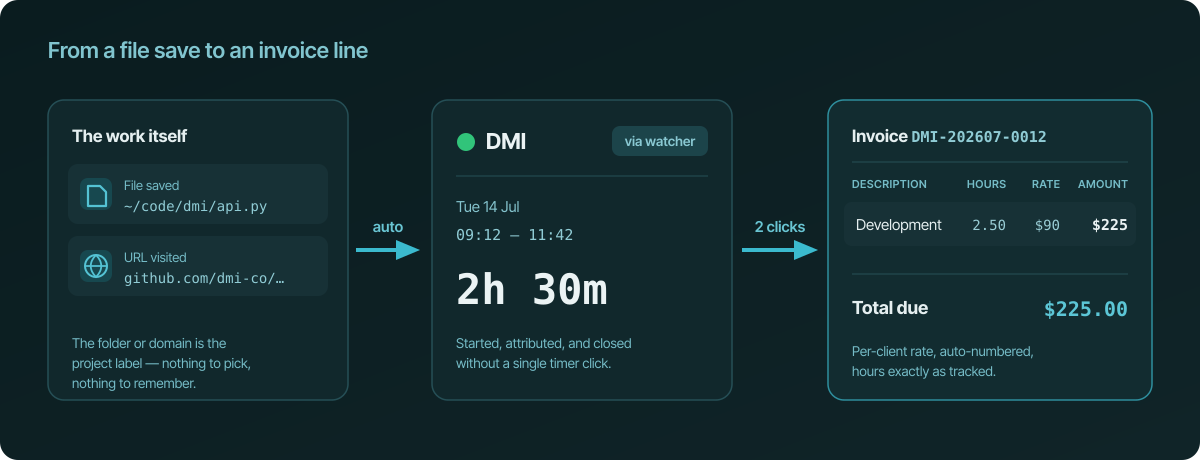
A file save or a visited URL starts the session and files it under the right project. No timers, no screenshots, no activity scores.
Invoices from tracked time
Projects link to clients with per-client hourly rates. Unbilled sessions become line items on auto-numbered invoices — nothing re-typed.
Hours that stay honest
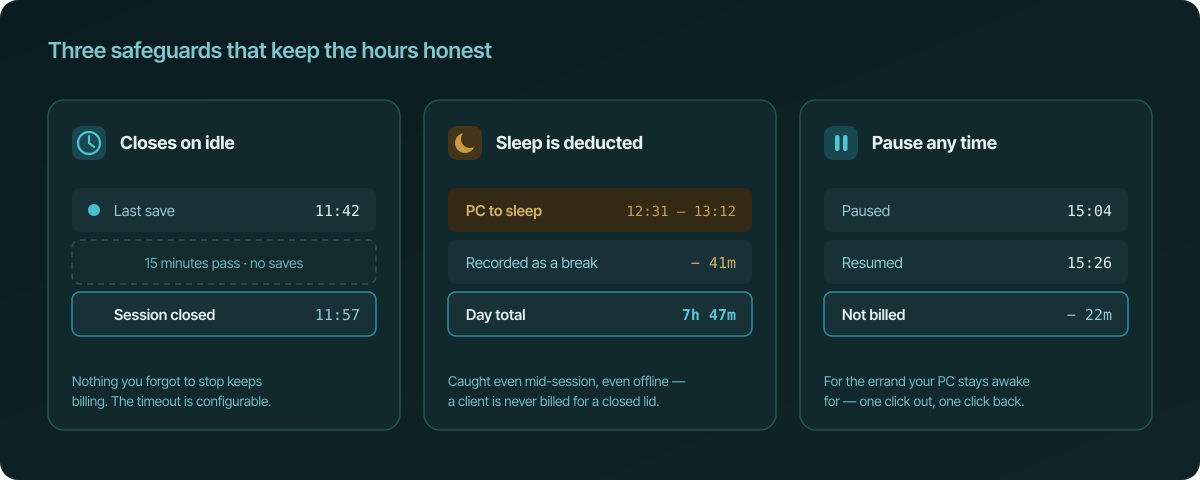
Sessions close by themselves after 15 idle minutes, time your PC spends asleep is deducted automatically, and you can pause with one click.
Sessions or whole days
Think in days, not sessions? Optional day-span mode shows one session per project per day, first save to last — reversible, and applies to your whole history.
Everywhere you work
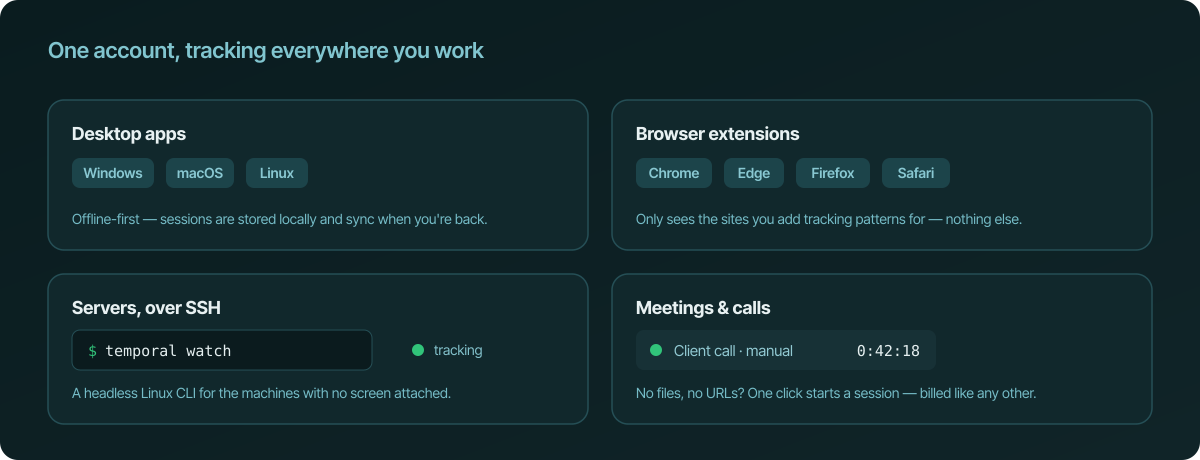
Apps for Windows, macOS, and Linux, a headless CLI for servers over SSH, and extensions for Chrome, Edge, Firefox, and Safari. Offline-first, syncs later.
Teams without surveillance
Organisation and team roll-ups with a live dashboard. Managers see project totals — never screenshots or keystroke records.
Frequently asked questions
How do I bill clients without screenshots?
Per-session activity logs (file paths, URLs, focused minutes). Most clients prefer the depth over the imagery.
Will this work for blue-collar / field teams?
Honestly, no. Stay with Hubstaff (or competitors with GPS) for field work.
Can I run this without my team feeling watched?
That's the design goal. Each user sees what's captured about themselves; managers see project totals, not keystroke records.
Ready to stop reconstructing your week?
Track time automatically. Bill clients in the same tool. No surveillance, ever.
Start tracking time, free